
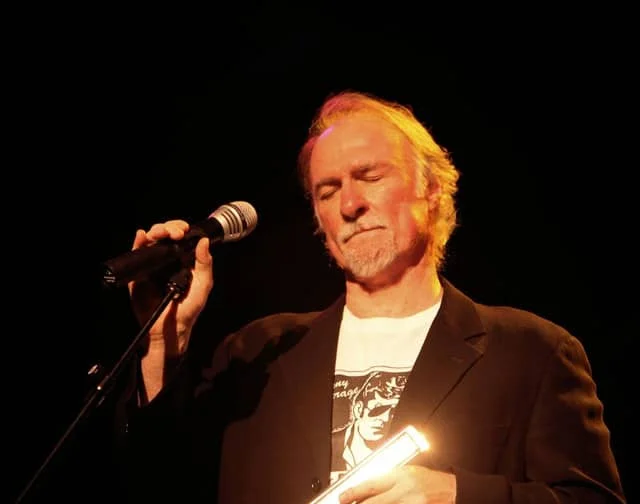

There are artists who chase fame, artists who stumble into it, and artists who find themselves forever defined by a comparison they never asked for. Robbie Dupree belongs squarely in the third category — a gifted songwriter and vocalist who rode a wave of smooth, blue-eyed soul into pop stardom in 1980, only to be branded by the music industry as “the next Michael McDonald.”
It was meant as a compliment. It became a burden. And decades later, it reads like an accidental prophecy.
When Dupree’s breakthrough single “Steal Away” hit radio in the summer of 1980, programmers did a double take. The voice sounded eerily familiar — that warm, husky, satin-smooth tone that had made McDonald the defining soul voice of the late ’70s with the Doobie Brothers and his own solo work. Some listeners thought it was McDonald. Others accused Dupree of imitation. Critics sharpened knives. But audiences didn’t care. The song soared to #6 on the Billboard Hot 100, riding a groove that felt like a soft ocean breeze — romantic, sleek, and immaculately produced.
The comparison stuck like Velcro.
Yet what critics missed — or willfully ignored — was that Dupree wasn’t copying Michael McDonald. He was swimming in the same musical waters: soul, R&B, gospel phrasing, and that distinctly late-’70s polish where groove mattered more than grit. If McDonald was the lighthouse, Dupree was another vessel navigating the same smooth tide.
And that tide, as it turns out, would later be called yacht rock.
The Birth of a Smooth Contender
Dupree didn’t emerge from a corporate pop assembly line. He was a working musician — a songwriter, keyboardist, and soul devotee steeped in Stevie Wonder, Marvin Gaye, and classic R&B phrasing. His 1980 self-titled debut album was no fluke. It went Platinum, buoyed by the success of “Steal Away” and the Top 20 follow-up “Hot Rod Hearts.”
These weren’t novelty hits. They were crafted, melodic, emotionally fluent pop records — the kind built to live in convertibles, summer nights, and soft-lit living rooms.
Dupree’s songs weren’t loud. They didn’t need to be. They whispered confidence. They leaned into romance. They carried a sense of effortless cool — the same smooth emotional language spoken by Christopher Cross, Boz Scaggs, Kenny Loggins, Toto, and yes, Michael McDonald.
That collective aesthetic would later be codified — sometimes mockingly, often lovingly — as yacht rock.
The Michael McDonald Shadow
To be labeled “the next Michael McDonald” in 1980 was both marketing gold and a creative curse.
On one hand, it gave Dupree instant credibility. McDonald was untouchable at the time — the reigning king of blue-eyed soul, the voice behind hits with the Doobies, Steely Dan, Kenny Loggins, and a growing solo career. If Dupree sounded like him, that meant radio programmers had a ready-made audience.
On the other hand, the comparison boxed Dupree into a narrative he couldn’t control.
Critics called him derivative. Some implied his success was built on mimicry rather than musicianship. But here’s the truth — a truth only time makes clear: Dupree wasn’t copying McDonald. He was part of the same musical lineage.
Soul singers share DNA. Nobody accused Otis Redding of copying Sam Cooke. Nobody accused Hall & Oates of copying Marvin Gaye. Musical kinship is evolution, not theft.
And in retrospect, Dupree’s voice doesn’t feel like a clone. It feels like a cousin.
A Founding Father of Yacht Rock — Before the Term Existed
Yacht rock didn’t exist as a label in 1980. It was invented later — half parody, half canonization — to describe a specific sonic universe: smooth rhythms, jazzy chords, emotional restraint, and immaculate studio craftsmanship.
But Robbie Dupree was already living in that universe.
Listen to “Steal Away.” The groove glides. The vocals are intimate, almost whispered. The production sparkles without flexing. It’s not rock. It’s not disco. It’s something more refined — music designed for night drives, ocean breezes, heartbreak without melodrama.
Dupree became a cornerstone of what would later be reclaimed as yacht rock royalty.
In the streaming era, his songs live comfortably alongside Michael McDonald, Toto, Christopher Cross, Steely Dan, and Boz Scaggs on curated playlists celebrating the genre. What once earned eye-rolls now earns reverence.
The smoothness aged like fine wine.
A Career Beyond the Spotlight
Pop stardom is a cruel business — especially if your debut sets impossible expectations.
Dupree’s later albums didn’t match the commercial explosion of his first, and as radio trends shifted toward new wave, MTV pop, and harder-edged rock, the industry’s attention moved on. But Dupree didn’t vanish. He kept touring, kept recording, and kept writing — choosing musicianship over tabloid mythology.
He avoided the archetypal rock-star implosion. No headline scandals. No spectacle. Just steady dedication to craft.
There’s something quietly admirable about that.
In an era when celebrity often mattered more than music, Dupree stayed rooted in sound.
The Redemption of Time
If the early ’80s framed Dupree as “the McDonald imitator,” the 2020s frame him as a pioneer of a beloved genre.
The yacht rock revival — fueled by streaming, nostalgia radio, memes, and Gen Z rediscovery — has recast his catalog in a new light. What once seemed over-polished now sounds timeless. What once felt “too smooth” now feels comforting, transportive, and oddly rebellious in its refusal to shout.
“Steal Away” has transcended its era. It’s no longer just a hit single — it’s a cultural artifact, a shorthand for a feeling: late summer, slow dancing, warm air, emotional honesty without theatrics.
And that’s no small legacy.
Not the Next Michael McDonald — Just Robbie Dupree
Here’s the irony: Robbie Dupree didn’t need to become Michael McDonald.
McDonald carved his lane. Dupree carved his — parallel, yes, but distinct. Where McDonald leaned into gospel grit and powerhouse phrasing, Dupree leaned into subtlety, softness, and emotional glide.
If McDonald was the storm, Dupree was the breeze.
History has been kinder than critics. It now sees Dupree not as a copy, but as a co-author of a movement — one of the artists who helped define the sophisticated, soulful pop that bridged the ’70s and ’80s.
And in the pantheon of yacht rock — that once-mocked, now-beloved genre — Robbie Dupree has secured his berth.
Not as a replacement for Michael McDonald.
But as a captain in his own right.


