

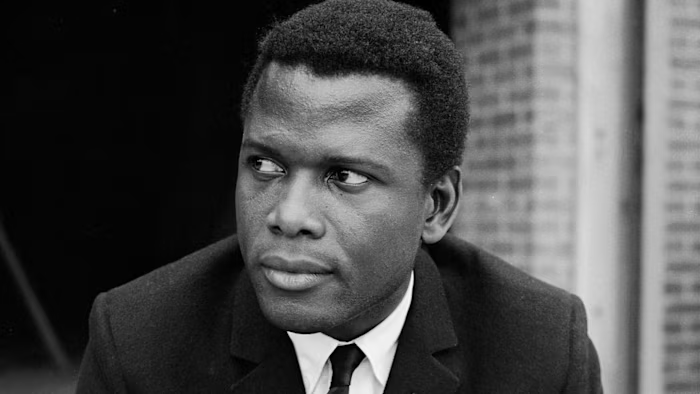

Sidney Poitier loved music the way some people love conversation—not loudly, not performatively, but with intention. Music, to him, wasn’t something you used to decorate a moment. It was the moment. It lived in living rooms after midnight, in kitchens with the lights low, in cars rolling slowly through Los Angeles while the city slept.
He didn’t chase the spotlight in music, but he stood close enough to feel the heat.
Poitier’s social circle tells the story better than any quote. If you wanted to understand his relationship with music, you didn’t look at his filmography—you looked at who he spent his time with. And that list reads like a liner note from the golden age of Black artistry.
At the center of it all was Harry Belafonte, his closest friend, his brother in arms, his co-conspirator. Their bond was built on politics, survival, and shared memory—but music was the glue. Belafonte’s apartment was a gathering place where records spun and conversations stretched until dawn. Folk songs, calypso, jazz—music was always playing, and Poitier was always listening.
Belafonte once said that Poitier had one of the best ears in the room. Not musically trained, but emotionally tuned. He could hear truth in a song. He knew when a lyric rang false. That sensitivity made him invaluable in those rooms, where artists came not to perform, but to be understood.Those rooms often included Sam Cooke, whose smooth voice masked a sharp, restless mind. Cooke and Poitier talked business, legacy, ownership—how Black artists could control their futures in industries built to exploit them. Music was the entry point, but the conversation always went deeper. Poitier admired Cooke’s courage as much as his voice.
Then there was Ray Charles, a regular presence in Poitier’s orbit. Ray didn’t need to explain music to Sidney. He felt it the same way—through rhythm, timing, instinct. They shared a love of gospel roots and the way sacred music could carry both joy and sorrow in the same breath. Ray once joked that Poitier had “a preacher’s pause,” a way of waiting just long enough to make people lean in.
Miles Davis drifted in and out of Poitier’s life like smoke—unpredictable, sharp-edged, brilliant. They weren’t close in the traditional sense, but there was mutual respect. Poitier admired Miles’ refusal to explain himself, his commitment to evolution. Miles, in turn, respected Poitier’s refusal to play anything less than fully human characters at a time when that came with real cost.
Music followed Poitier everywhere. He loved jazz at home—Coltrane, Ellington, Monk—but gospel stayed closest to his heart. It reminded him of Cat Island, of voices rising together without microphones or applause. When life in Hollywood became heavy, he returned to those sounds. Music grounded him.
Dinner parties at Poitier’s home were legendary. The food was good, the talk better, but the records were the real host. You might hear Nina Simone one minute, Billie Holiday the next. Simone, in particular, fascinated him. He admired her fearlessness, her refusal to separate art from truth. They shared a belief that silence, when chosen, could be louder than protest.
Poitier never tried to be “cool” about music. He didn’t name-drop. He didn’t posture. He simply showed up, listened, and remembered. Friends noticed that he absorbed music the way an actor absorbs a script—listening for meaning beneath the words.
That love of music wasn’t about taste. It was about connection. Music was how he stayed tethered to community in an industry designed to isolate. It was how he relaxed, how he learned, how he stayed human.
Late in life, Poitier spoke about how much he missed those nights—the laughter, the arguments, the records flipped over one more time. Many of the voices he loved were gone, but the music remained. It always does.
Sidney Poitier didn’t need to sing. He lived close enough to the song to let it shape him. And if you listen carefully to his life—not just his films—you can still hear it playing.


