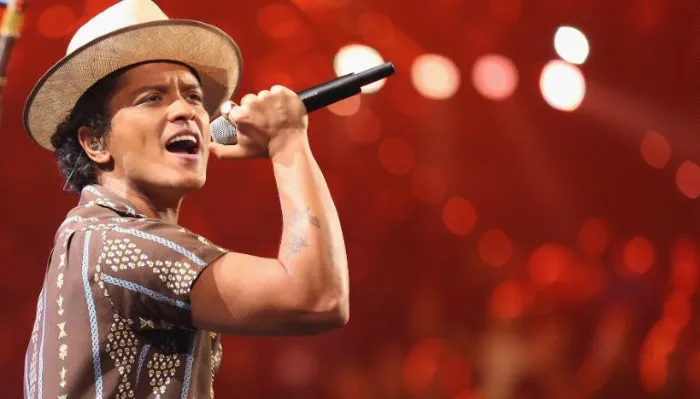

You can’t understand Bruno Mars without understanding the ’70s. Not the costume version of the decade—the bell-bottoms-and-disco-ball shorthand—but the deeper current: the grooves that moved hips before they moved units, the singers who knew how to flirt without shouting, the bands that treated rhythm like religion. Bruno didn’t just borrow from that era; he studied it. Lived in it. Learned how restraint could hit harder than volume.
When I first heard Bruno Mars, really heard him, I didn’t think “new.” I thought familiar. Like walking into a room you didn’t know you missed. His music felt inherited, passed down through vinyl grooves and late-night radio, through artists who understood that pop could be sophisticated and sexy at the same time.
Here are six artists and bands from the 1970s who quietly—and sometimes loudly—shaped the sound Bruno Mars would later turn into global gold.
1. Stevie Wonder
Stevie Wonder isn’t an influence—you don’t “influence” Bruno Mars; you raise him.
What Stevie perfected in the ’70s was total musical freedom. Talking Book, Innervisions, Songs in the Key of Life—these records danced, preached, flirted, and protested, sometimes all in the same song. Stevie showed Bruno that you could be joyful and serious, funky and melodic, technically brilliant and emotionally generous.
Listen to Bruno’s chord changes, the way melodies glide instead of punch. That’s Stevie’s school. The confidence to stack harmonies, to let keyboards drive the groove, to trust that listeners could handle complexity—as long as the feeling stayed right. Stevie taught Bruno that funk doesn’t have to sweat to be sexy. Sometimes it just smiles and keeps walking.
2. James Brown
If Stevie taught Bruno how to feel, James Brown taught him how to move.
James Brown in the ’70s was less singer than rhythmic dictator. Everything snapped into place around the One. No wasted motion. No unnecessary notes. Funk stripped to its skeleton and rebuilt into something militant and ecstatic.
You hear James Brown in Bruno’s sense of discipline. In the way the band locks in. In the tight arrangements that leave room for swagger. Songs like “24K Magic” and “Uptown Funk” don’t sprawl—they command. That’s pure James Brown energy: music that tells your body what to do before your brain catches up.
Bruno didn’t just absorb the sound—he absorbed the ethic. Showmanship as precision. Groove as authority.
3. Prince
Prince was the bridge between funk and fantasy, and Bruno crossed it gladly.
In the late ’70s, Prince took the lessons of James Brown and Stevie Wonder and filtered them through desire. Not romance—desire. Falsetto as weapon. Minimalism as seduction. Songs that felt private even when blasted through arena speakers.
Bruno’s falsetto owes a debt to Prince’s fearlessness. Prince taught him that vulnerability could be sexy, that a man could sing high and still own the room. The playful sexuality, the confidence, the idea that funk could wink instead of glare—that’s Prince’s fingerprint.
Prince also showed Bruno that genre lines were optional. Funk, pop, rock, R&B—they were all just colors. Use what you need. Throw the rest away.
4. Earth, Wind & Fire
If Bruno Mars loves joy—and he does—it came straight from Earth, Wind & Fire.
They were masters of uplift. Big bands with big ideas. Horns that sounded like sunlight. Grooves that felt communal, like everyone in the room had already agreed to dance. Earth, Wind & Fire proved that funk could be elegant, that pop could be spiritual without being heavy.
You hear it in Bruno’s arrangements—the horns that punch without overwhelming, the choruses that feel built for shared experience. Songs that sound like celebrations instead of performances.
They also taught him professionalism. Precision. The idea that joy works best when everyone knows exactly what they’re doing.
5. The Isley Brothers
The Isley Brothers were shape-shifters, and that flexibility lives inside Bruno’s catalog.
In the ’70s, the Isleys moved effortlessly between rock, funk, soul, and slow-burning sensuality. One minute they’re grinding (“That Lady”), the next they’re whispering devotion (“For the Love of You”). They understood contrast—how to turn intensity on and off.
That emotional range is crucial to Bruno Mars’ appeal. He can make you dance, then turn around and make you feel something tender without sounding soft. The Isleys taught him that masculinity in music doesn’t have to be rigid. It can be smooth. It can be romantic. It can change its clothes.
6. Sly & the Family Stone
Sly Stone didn’t just make funk—he expanded it.
In the late ’60s and early ’70s, Sly blurred lines: black and white, male and female, sweet and abrasive. His music was loose but intentional, chaotic but joyful. Funk as social statement, groove as rebellion.
Bruno Mars inherited that openness. That sense that funk is about inclusion, about bringing people together through rhythm. Even when Bruno’s songs are polished, there’s still that Sly-like looseness underneath—a reminder that music should feel alive, not overmanaged.
Sly taught him that groove is democratic. Everybody gets a voice. Everybody gets a moment.
The Throughline
What ties all these artists together—and what Bruno Mars understood instinctively—is that sexiness, funk, and pop greatness are never accidents. They’re crafted. Considered. Felt deeply.
The ’70s artists Bruno channels didn’t chase trends. They set them. They trusted musicianship. They trusted feeling. They trusted that audiences could tell the difference between something real and something rushed.
Bruno Mars didn’t revive the ’70s. He translated them. He took their lessons—discipline, joy, sensuality, groove—and gave them a modern vocabulary. That’s why his music doesn’t feel retro. It feels timeless.
Because when you build on Stevie’s freedom, James Brown’s discipline, Prince’s daring, Earth, Wind & Fire’s joy, the Isley Brothers’ intimacy, and Sly Stone’s humanity, you’re not copying history.
You’re continuing it.
And that, more than any outfit or falsetto, is why Bruno Mars sounds like he belongs forever.