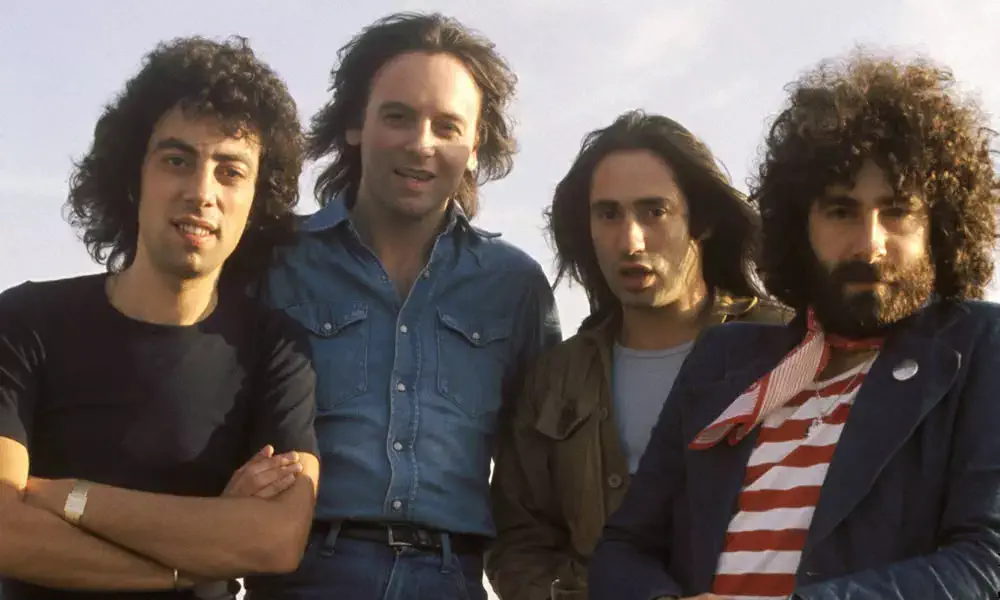

Few songs from the 1970s feel as otherworldly as I’m Not in Love. Released in 1975 by the British art-pop band 10cc, the track became a global hit and remains one of the most innovative recordings of the analog era.
But while the song elevated the band to international fame, it also marked a turning point. Not long after its success, the classic lineup fractured.
In this article, we’ll explore:
- Why 10cc split after their biggest hit
- What the band name “10cc” supposedly means
- How they technically built the groundbreaking vocal loop system behind the song
Let’s dive in.
Why Did 10cc Break Up After “I’m Not in Love”?
At the height of their success, 10cc consisted of four core members:
- Eric Stewart
- Graham Gouldman
- Kevin Godley
- Lol Creme
While they appeared unified, the group was creatively divided into two camps.
Two Creative Directions
Stewart and Gouldman leaned toward melodic, structured pop songwriting. They valued accessibility, hooks, and strong commercial appeal.
Godley and Creme, by contrast, were experimentalists. They were fascinated by studio innovation, satire, and pushing rock music into avant-garde territory.
When “I’m Not in Love” became a massive international hit—reaching No. 1 in the UK and No. 2 in the United States—it validated the more accessible songwriting direction.
However, that success intensified underlying creative differences.
The Breaking Point
After the release of the album The Original Soundtrack in 1975, tensions increased. Godley and Creme wanted to pursue ambitious conceptual projects and radical experimentation. Stewart and Gouldman preferred refining 10cc’s pop craftsmanship and building on their chart success.
By 1976, Godley and Creme left the band to pursue their own artistic ventures, including the ambitious project Consequences. Stewart and Gouldman continued recording as 10cc, producing hits like “The Things We Do for Love.”
The breakup wasn’t dramatic or scandalous. It was philosophical. Two different visions of what 10cc should become could no longer coexist.
What Does “10cc” Mean? (The Funny Story Behind the Name)
One of the most searched questions about the band is: What does 10cc mean?
The story most often repeated is that “10cc” refers to the average volume of male ejaculate—measured in cubic centimeters.
Yes, that’s the legend.
According to band lore, their manager claimed to have dreamed of a band called “10cc,” and the number stuck because it sounded scientific, clinical, and slightly provocative.
Whether medically precise or not, the name fit the band’s personality—clever, ironic, and a little mischievous. It stood out from the mystical and grandiose band names of the 1970s.
The name was short, strange, and impossible to ignore—just like their music.
How 10cc Built the Vocal Loops for “I’m Not in Love”
The most revolutionary element of “I’m Not in Love” is its lush, floating background sound. Many listeners assume it was created using synthesizers.
It wasn’t.
Instead, 10cc built the sound entirely from layered human voices using analog tape loops at Strawberry Studios in Stockport.
Here’s how they did it.
Step 1: Recording Individual Notes
Rather than recording full harmonies, the band recorded sustained “ahhh” notes one pitch at a time.
They recorded multiple takes of each note in the chromatic scale across several octaves. Each member sang the notes repeatedly to build density.
This created a library of individual vocal tones.
Step 2: Creating Physical Tape Loops
Each recorded note was transferred onto a loop of analog tape approximately 12–15 feet long.
These loops were physically stretched around the studio—often around mic stands—to create continuous playback cycles.
Every loop contained one specific pitch.
This meant that instead of playing chords on a keyboard, the band essentially created a playable vocal instrument using tape.
Step 3: Turning the Mixing Desk Into an Instrument
Each tape loop was assigned to a separate fader on the mixing console.
To create a chord, engineers manually raised the faders corresponding to the desired notes.
There was no digital automation, no MIDI, no sampling technology. Everything was controlled by hand.
The result was a massive, choir-like texture made entirely of layered human voices.
Step 4: Managing Tape Hiss and Stability
Analog tape introduced noise. With dozens of loops running simultaneously, tape hiss could quickly accumulate.
To combat this, the band:
- Carefully controlled recording levels
- Used noise reduction techniques
- Frequently re-recorded and balanced layers
The process was meticulous and time-consuming.
Step 5: Minimal Percussion for Maximum Atmosphere
Unlike most pop songs of the era, “I’m Not in Love” avoids heavy drums.
By minimizing rhythm, the band created a suspended, weightless atmosphere. The song feels as if it’s floating—without the grounding of a strong beat.
This production choice gives the track its timeless quality.
Why “I’m Not in Love” Still Sounds Modern
Even decades later, the song feels contemporary.
Why?
Because it doesn’t rely on production trends typical of the mid-1970s. There’s no disco groove, no flashy guitar solos dominating the mix, and no overproduced orchestration.
Instead, the arrangement focuses on space, restraint, and emotional tension.
The lyrics tell the story of a man denying his feelings, even as the sweeping vocal arrangement betrays the depth of his emotion. The contrast between denial and vulnerability gives the song lasting resonance.
The Legacy of 10cc
After the split, Stewart and Gouldman continued under the 10cc name and enjoyed further success. Meanwhile, Godley and Creme became pioneers in music video production during the MTV era.
Though the original lineup was short-lived, their collaborative peak produced one of the most innovative recordings in rock history.
“I’m Not in Love” wasn’t just a hit single. It was a technical breakthrough that demonstrated how far creativity and analog recording techniques could go without digital tools.
Final Thoughts
The story of 10cc is ultimately about creative tension.
“I’m Not in Love” became their defining moment—not because it was simple, but because it was daring. Its success amplified philosophical differences within the band, leading to a split that reshaped their future.
The band name may have started as a joke. The recording process may have been painstaking. The breakup may have been inevitable.
But the song remains.
A floating, breath-built cathedral of sound—crafted from tape loops, human voices, and four musicians whose creative chemistry burned bright, even if it didn’t last forever.