

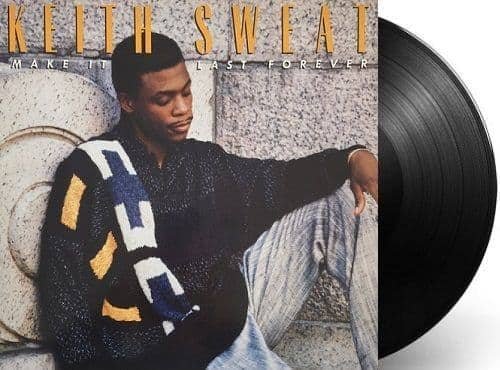

Keith Sweat’s Make It Last Forever: A Song-by-Song Deep Dive Into the Album That Changed R&B
In 1987, R&B didn’t just shift — it pivoted.
The drum machines hit harder. The basslines got leaner. The romance stayed intact, but it started wearing sneakers instead of silk robes. That pivot point? A young Harlem singer with a pleading falsetto and a hustler’s instinct named Keith Sweat.
His debut album, Make It Last Forever, didn’t politely knock on the door of the charts. It kicked it in.
I remember hearing “I Want Her” for the first time in a packed club in New York. The DJ let that bassline roll for a few seconds before Keith’s voice slipped in — nasal, urgent, unpolished in a way that felt real. The floor changed. The temperature changed. Something was happening.
That something had a name: New Jack Swing.
Produced largely by a young visionary named Teddy Riley, Make It Last Forever became a blueprint. It fused hip-hop rhythm with classic R&B longing. It made vulnerability groove.
Let’s go cut by cut and revisit every track — not just as songs, but as cultural markers.
1. “Something Just Ain’t Right”
The album opens not with fireworks but with tension.
“Something Just Ain’t Right” feels like walking into a room where the argument has already started. The synth stabs are tight and clipped. The drum machine snaps with precision. There’s no lush intro — just a groove that locks in.
Keith doesn’t oversing. He questions. His voice quivers slightly as he confronts a lover’s infidelity. It’s not theatrical heartbreak. It’s suspicion simmering.
Teddy Riley’s production here is surgical. The bass doesn’t overwhelm; it pulses. The hi-hats tick like a clock. You can hear the hip-hop influence in the drum programming — sharper than traditional R&B.
As an opener, it sets the tone: this isn’t fantasy romance. This is street-level love.
2. “Right and a Wrong Way”
Now we’re talking.
“Right and a Wrong Way” is the song that separated Keith from his peers. Where others crooned, he instructed. The groove is slow, deliberate, sensual without being syrupy.
This track is pure bedroom choreography.
Keith’s vocal approach is conversational. He doesn’t belt. He leans in. The chorus glides, not explodes. It’s about patience, about learning a partner’s rhythm. In a genre often driven by bravado, this felt intimate.
The production is spare — just enough synth pads and drum programming to cradle the vocal. Teddy Riley understood restraint. He let the space speak.
To this day, it’s one of the most recognizable slow jams of the late 80s. When it comes on at a reunion party, conversations pause.
3. “Tell Me It’s Me You Want”
Here the tempo nudges upward.
“Tell Me It’s Me You Want” carries more bounce, more flirtation. The bassline walks with confidence. The drum pattern is unmistakably New Jack — crisp snares, syncopated kicks.
Keith’s delivery is urgent but playful. He’s not pleading here; he’s seeking affirmation.
What stands out is the layering of background vocals. They’re subtle but effective, adding dimension without overwhelming the lead.
This is the sound of R&B modernizing in real time.
4. “Make It Last Forever” (feat. Jacci McGhee)
The title track is the album’s emotional centerpiece.
Featuring Jacci McGhee, this duet stretches past eight minutes in its full version — and never feels indulgent.
The intro alone is iconic. Soft keys. A slow-building groove. Then Keith enters, tender and restrained.
When Jacci answers, the chemistry sparks. Their voices intertwine rather than compete. It’s call-and-response intimacy.
This isn’t a quick romance. It’s about longevity. Commitment. Stretching passion beyond a moment.
I’ve heard this song at weddings, at anniversary parties, at quiet late-night gatherings. It ages well because its message is timeless.
Production-wise, Riley balances minimalism with atmosphere. The extended instrumental sections allow the groove to breathe. It’s seductive without being slick.
5. “In the Rain”
A cover of the classic originally recorded by The Dramatics, “In the Rain” connects Keith to R&B’s lineage.
Covering a soul staple is risky. But instead of imitating the original’s lush orchestration, Keith and Riley reimagine it through a New Jack lens.
The drums are tighter. The synth textures replace strings. Keith’s vocal interpretation is more restrained, less theatrical.
It works because he doesn’t overreach. He respects the song’s vulnerability.
It’s a nod to the past without abandoning the present.
6. “I Want Her”
The breakthrough.
“I Want Her” is lean, hypnotic, relentless. The bassline loops like a mantra. The drum machine punches with precision.
Keith’s vocal here is raw. There’s hunger in it. Not metaphorical hunger — literal desire.
The brilliance of this track lies in its simplicity. No unnecessary chord changes. No ornate bridges. Just groove and insistence.
When it hit radio, it felt different. Harder. More urban. It pulled R&B closer to hip-hop’s edge.
This song didn’t just climb charts. It redefined them.
7. “How Deep Is Your Love”
Not to be confused with the Bee Gees classic, this is an entirely different mood.
“How Deep Is Your Love” leans into mid-tempo introspection. The synth pads are thicker here, creating atmosphere.
Keith questions loyalty again — a recurring theme across the album. Trust, doubt, affirmation. Love as negotiation.
His falsetto cracks slightly in places, but that imperfection makes it believable. He’s not a pristine vocalist. He’s emotive.
And emotion wins.
8. “Don’t Stop Your Love”
We close with uplift.
“Don’t Stop Your Love” carries optimism. The groove is smoother, less tense than the opener.
It feels like resolution — as if the doubts earlier in the album have been worked through.
The production remains tight, but there’s warmth here. The background vocals swell slightly. The chord progression feels hopeful.
It’s a fitting conclusion to an album rooted in romantic realism.
The Bigger Picture
Make It Last Forever wasn’t just a debut. It was a declaration.
It helped usher in the New Jack Swing era, influencing artists like Bobby Brown and later groups like Guy.
But what makes it endure isn’t just production innovation. It’s emotional authenticity.
Keith Sweat didn’t present himself as untouchable. He questioned. He desired. He doubted. He committed.
That vulnerability, wrapped in hard-edged drum programming, created a new archetype for male R&B artists.
Listening back now, decades removed, the album still feels cohesive. There’s no filler. Each track contributes to the narrative of love — complicated, sensual, uncertain.
And maybe that’s why it lasts.
Because real love stories don’t age.
They evolve.
Just like the music.


![Why Gen Z is Obsessed with 1970s [Genre: Funk/Soul/Disco/Glam Rock].](https://i3.wp.com/cdn.pixabay.com/photo/2017/07/27/12/40/sommerfest-2545191_960_720.jpg?w=300&resize=300,150&ssl=1 "Why Gen Z is Obsessed with 1970s [Genre: Funk/Soul/Disco/Glam Rock].")
