

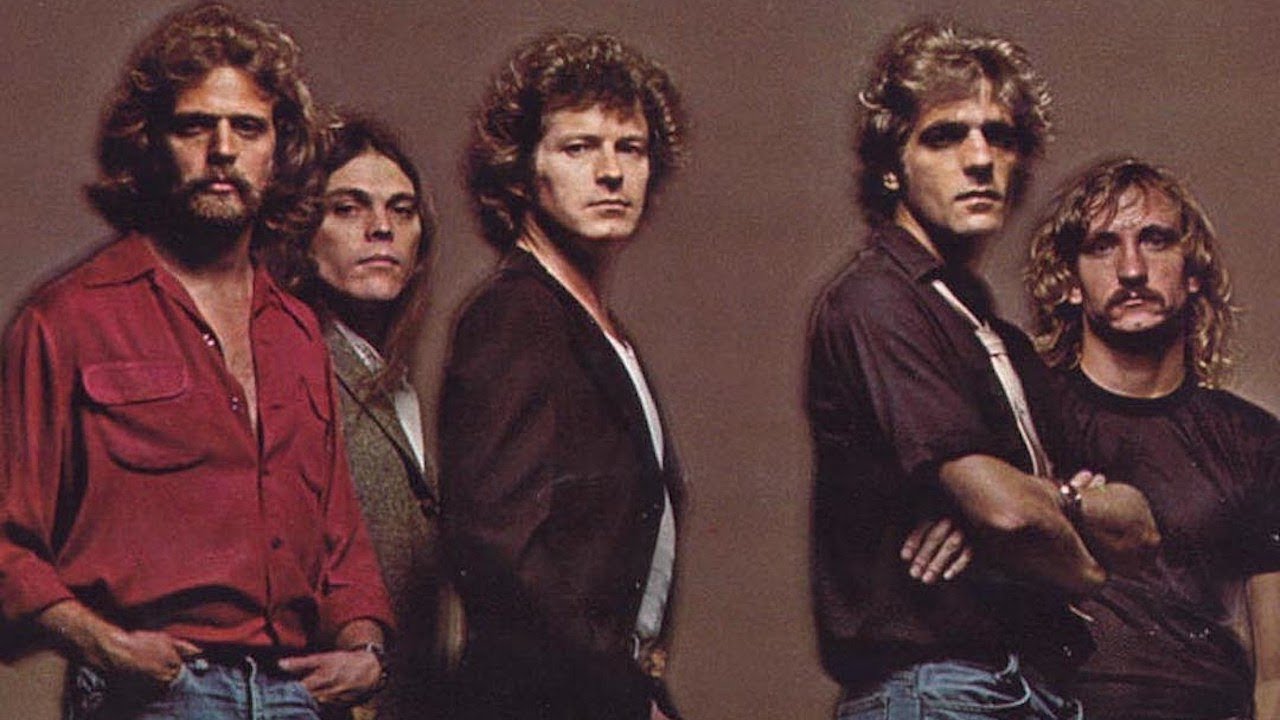

There’s a certain kind of Eagles song that announces itself loudly—big harmonies, wide-open highways, mythic West Coast imagery baked into every chorus. And then there’s “I Can’t Tell You Why,” a song that doesn’t announce anything at all. It just shows up quietly, closes the door behind it, and sits with you in the half-light. No swagger. No epic declaration. Just a feeling you recognize immediately, even if you’ve never quite been able to explain it yourself.
That’s part of what makes “I Can’t Tell You Why” so unusual in the Eagles catalog. It wasn’t born from the dominant songwriting partnership of Don Henley and Glenn Frey. Instead, it came primarily from Timothy B. Schmit, the band’s newest member at the time—and that fact alone makes it something of a turning point. This was a band known for tight control, carefully managed roles, and a well-established sound. Letting the new guy step forward with a deeply personal song wasn’t just rare; it was a quiet act of trust.
Schmit had joined the Eagles in 1977, replacing founding member Randy Meisner. It was an unenviable position—stepping into a hugely successful band with a devoted fanbase and strong personalities already in place. For a while, Schmit blended in seamlessly, adding his unmistakable high harmonies but staying largely out of the spotlight. “I Can’t Tell You Why” changed that. It became the first Eagles single to feature Schmit on lead vocals, and with it, he proved he wasn’t just filling a seat—he was reshaping the room.
Stylistically, the song marked a subtle but significant shift. Instead of the band’s familiar country-rock backbone or polished arena-ready sound, “I Can’t Tell You Why” leans into smooth R&B and soft soul. The groove is gentle, almost hushed. The arrangement feels intentionally restrained, as if the band is careful not to disturb the mood. It was a reminder that vulnerability could be just as powerful as bravado—and far more intimate.
Lyrically, the song often gets mistaken for a breakup anthem, but that misses the point. Schmit has been clear: this isn’t about betrayal or dramatic endings. It’s about emotional confusion—that uneasy middle ground where something feels wrong, but you can’t quite name it. The relationship hasn’t collapsed, but it isn’t whole either. That ambiguity is the song’s emotional engine.
Lines like “Every time I think I’ve got a hold on you / It seems you slip away” don’t accuse or condemn. They hover. The narrator isn’t angry; he’s puzzled. He isn’t lashing out; he’s pulling inward. There’s a quiet resignation in the delivery, a sense that the problem isn’t just the other person—it’s the inability to articulate what’s happening at all. In that way, “I Can’t Tell You Why” captures something profoundly human: the frustration of not having the language for your own feelings.
Musically, the Eagles supported that emotional tone with remarkable discipline. Don Felder’s guitar solo is one of his most understated—melodic, tasteful, and deliberately low-key. It doesn’t soar; it sighs. The rhythm section keeps everything smooth and nocturnal, creating a soundscape that feels like 2 a.m., when doubts creep in and answers refuse to show up. It’s a song designed for late-night listening, when you’re alone with your thoughts and the radio feels like a companion rather than a distraction.
The timing of the song adds another layer of meaning. “I Can’t Tell You Why” was recorded during sessions for The Long Run (1979), an album made under enormous pressure. The Eagles were exhausted, successful to a fault, and increasingly divided. Tempers flared. Patience wore thin. The band that once thrived on harmony—musical and otherwise—was beginning to fracture.
In hindsight, it’s impossible not to hear “I Can’t Tell You Why” as an unintentional metaphor for the Eagles themselves. A group that looked flawless from the outside, polished and professional, yet internally strained and emotionally distant. They knew something was wrong, but no one could quite say it out loud. The song didn’t cause the breakup, but it seems to sense it coming.
Commercially, the track proved that quiet songs could still connect. Released as a single, it climbed into the Top 10, resonating with listeners who may not have seen themselves in the Eagles’ larger-than-life narratives but recognized the emotional truth here immediately. It became a staple of late-night radio, a song people leaned into rather than sang along with.
That’s why “I Can’t Tell You Why” endures. It doesn’t resolve its tension. It doesn’t offer closure. It doesn’t wrap things up neatly. Instead, it sits with uncertainty and allows it to breathe. In a catalog filled with iconic harmonies and unforgettable hooks, this song stands apart by whispering where others shouted.
And sometimes, that’s exactly what lasts the longest.


![Why Gen Z is Obsessed with 1970s [Genre: Funk/Soul/Disco/Glam Rock].](https://i3.wp.com/cdn.pixabay.com/photo/2017/07/27/12/40/sommerfest-2545191_960_720.jpg?w=300&resize=300,150&ssl=1 "Why Gen Z is Obsessed with 1970s [Genre: Funk/Soul/Disco/Glam Rock].")

