
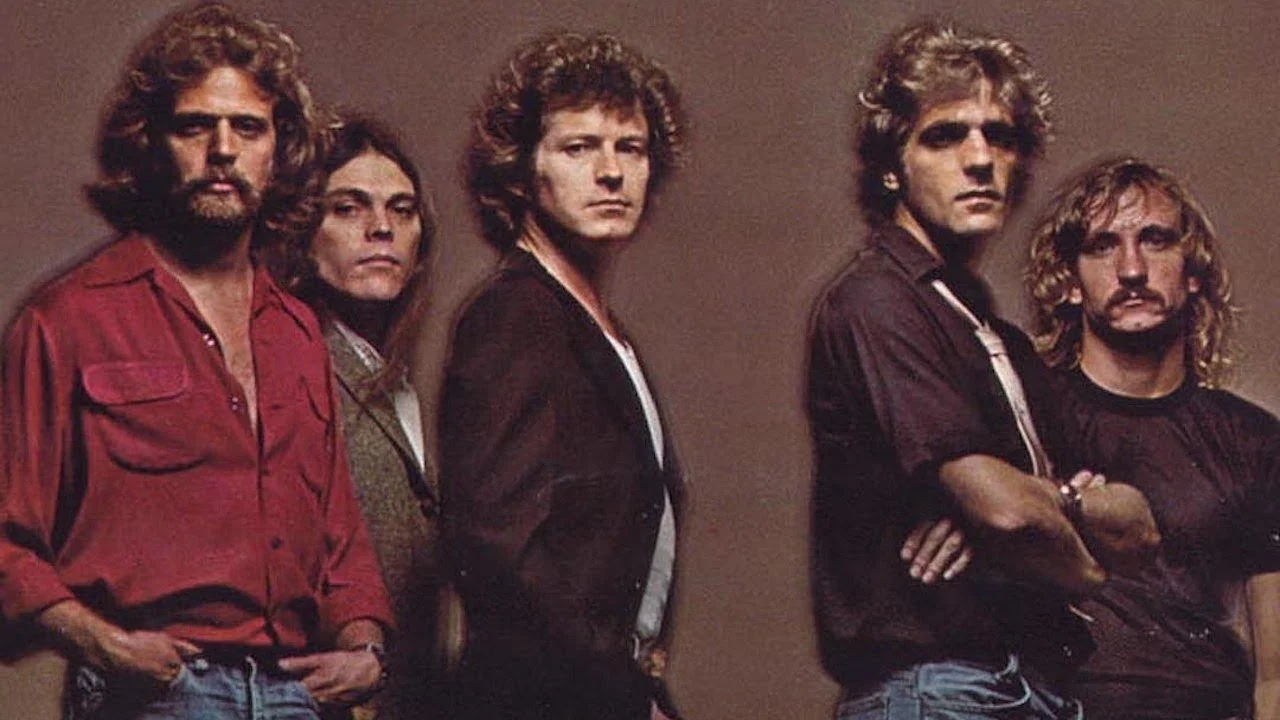

A Different Kind of Eagles Song
By the late ’70s, the Eagles had already defined a sound so iconic it felt permanent. Songs like “Hotel California” and “Take It Easy” had cemented their identity—sunburned California storytelling wrapped in pristine harmonies. At the center of it all were Don Henley and Glenn Frey, the band’s core songwriting engine.
But “I Can’t Tell You Why” didn’t come from that engine.
It came from Timothy B. Schmit—the new guy.
And that matters more than it might seem.
Because the Eagles weren’t a band that casually handed over the microphone. Their success was built on control—tight arrangements, defined roles, a hierarchy that rarely shifted. For Schmit to step forward with a deeply personal track—and for the band to embrace it—wasn’t just unusual.
It was a quiet turning point.
The Sound of 2 A.M.
Timothy B. Schmit Steps Into the Light
Schmit joined the Eagles in 1977, replacing Randy Meisner. It was the kind of gig that looks glamorous from a distance and terrifying up close. Meisner had been a founding member. The band was already massive. Expectations weren’t just high—they were towering.
For a while, Schmit did what smart musicians do in that situation: he blended in.
His high harmonies fit seamlessly into the Eagles’ vocal architecture. He supported. He elevated. But he stayed just outside the spotlight.
Until this song.
“I Can’t Tell You Why” became the first Eagles single to feature Schmit on lead vocals—and when you hear it, you understand why it had to be him. His voice doesn’t push. It doesn’t demand attention. It draws you in. There’s a softness to it, but also a quiet ache that feels lived-in.
He wasn’t just filling a role anymore.
He was redefining it.
A Smooth Shift: Rock Meets R&B
From an SEO standpoint, if you’re searching for “Eagles sound evolution” or “why ‘I Can’t Tell You Why’ sounds different,” this is where the answer lives.
Because stylistically, the song is a departure.
Instead of the band’s familiar country-rock backbone, “I Can’t Tell You Why” leans into smooth R&B and soft soul. The groove is restrained, almost weightless. It doesn’t drive forward—it drifts.
That choice changes everything.
The drums don’t punch; they pulse. The bass doesn’t anchor; it glides. The keyboards create space instead of filling it. It’s the Eagles, but filtered through a late-night, after-hours sensibility that feels closer to soul than rock.
This wasn’t accidental. It reflected a broader shift happening in late-’70s music, where genre lines were beginning to blur. Rock bands were absorbing R&B textures. Soul artists were experimenting with pop structures.
And here were the Eagles—arguably the kings of polished California rock—stepping into that space with surprising grace.
Lyrics That Live in the Gray Area
Search “meaning of ‘I Can’t Tell You Why’” and you’ll find a common assumption: it’s a breakup song.
But that’s not quite right.
The real story is more complicated—and far more interesting.
Schmit has said the song isn’t about a dramatic ending. There’s no betrayal. No explosive confrontation. Instead, it captures something subtler: emotional confusion.
That uneasy middle ground.
The relationship isn’t over—but it isn’t working either.
And no one can quite explain why.
That ambiguity becomes the song’s emotional core. Lines like “Every time I think I’ve got a hold on you / It seems you slip away” don’t accuse. They don’t even fully question. They hover.
The narrator isn’t angry.
He’s searching.
And what he’s searching for isn’t the other person—it’s clarity.
That’s what makes the song so enduring. It taps into a universal experience: the frustration of not having language for your own feelings. Of knowing something is off, but not being able to define it.
In a world full of songs that tell you exactly what went wrong, “I Can’t Tell You Why” does something braver.
It admits it doesn’t know.
If you’ve ever searched for “best late-night songs” or “songs for overthinking relationships,” this track belongs at the top of the list.
Because musically, it feels like 2 a.m.
Everything about the arrangement supports that mood. Don Felder delivers one of the most restrained guitar solos of his career. It doesn’t soar. It doesn’t show off.
It sighs.
Each note feels considered, almost hesitant, as if it’s afraid to break the spell. It’s not trying to impress you. It’s trying to stay honest.
The rhythm section follows that same philosophy. Nothing is rushed. Nothing is forced. The song breathes in a way that most radio hits don’t.
And that breathing space is what pulls you in.
It gives you room to think.
Room to feel.
Room to project your own story onto it.
The Long Run: Pressure Behind the Music
To fully understand “I Can’t Tell You Why,” you have to understand the environment it was created in.
The song was recorded during sessions for The Long Run—an album that came with enormous pressure.
The Eagles weren’t just successful at this point. They were expected to be successful. Every move was scrutinized. Every delay became a headline.
And internally, the band was starting to crack.
Tensions between members were rising. Creative disagreements became personal. The easy camaraderie that had defined their early years was giving way to something more strained.
You can hear that tension across The Long Run.
But on “I Can’t Tell You Why,” it surfaces in a different way.
Not as anger.
Not as conflict.
But as quiet disconnection.
An Unintentional Mirror
Looking back, it’s hard not to hear the song as a reflection of the band itself.
From the outside, the Eagles still looked flawless—chart-topping hits, sold-out tours, a reputation for precision and professionalism.
But inside, something wasn’t right.
Communication was breaking down. Relationships were fraying. And like the narrator in the song, no one could quite articulate why.
That’s what gives “I Can’t Tell You Why” its haunting quality.
It doesn’t just describe a relationship in limbo.
It embodies it.
Chart Success Without the Noise
Despite its understated nature, the song connected.
Released as a single, it climbed into the Top 10—proof that audiences were willing to meet the Eagles in a quieter space. Not every hit needed to be an anthem. Not every chorus needed to explode.
Sometimes, listeners just wanted something real.
“I Can’t Tell You Why” became a staple of late-night radio, the kind of song that feels like it’s playing just for you. It wasn’t about singing along at the top of your lungs.
It was about leaning in.
Why the Song Still Resonates Today
Search trends today tell an interesting story: people are still looking for songs about emotional confusion, complicated relationships, and unresolved feelings.
That’s exactly where this track lives.
It doesn’t offer closure. It doesn’t provide answers. It doesn’t even pretend to.
Instead, it does something more valuable—it validates uncertainty.
In a culture that often demands clarity, that’s a powerful thing.
The song reminds us that not every story has a clean ending. Not every feeling can be neatly defined. Sometimes, the most honest thing you can say is:
“I don’t know.”
The Quiet Legacy of a Loud Band
In the Eagles’ catalog—filled with massive hits, unforgettable hooks, and larger-than-life imagery—“I Can’t Tell You Why” stands apart.
It whispers where others shout.
It reflects where others declare.
And in doing so, it reveals a different side of the band—one that’s just as important, if not more so.
Because beneath all the polish, all the success, all the mythology, there was always something human at the core.
This song lets you hear it.
Final Thoughts: The Power of Restraint
If you’re building a playlist of “best Eagles songs” or exploring “deep cuts that define a band,” this track deserves a place near the top—not because it’s the biggest, but because it’s one of the most revealing.
“I Can’t Tell You Why” isn’t about spectacle.
It’s about space.
Space to feel. Space to question. Space to sit with something unresolved.
And maybe that’s why it lasts.
Because long after the big choruses fade and the anthems quiet down, it’s the songs that understand uncertainty—the ones that don’t try to solve the mystery—that stay with you.
Sometimes the loudest thing a song can do… is barely raise its voice at all.


